Working together, communities have the power to create transformative outcomes for children, youth and families. PlaceBasedPartnerships.org provides the right tools for them to do it.
Working together, communities have the power to create transformative outcomes for children, youth and families. PlaceBasedPartnerships.org provides the right tools for them to do it.
Working together, communities have the power to create transformative outcomes for children, youth and families. PlaceBasedPartnerships.org provides the right tools for them to do it.
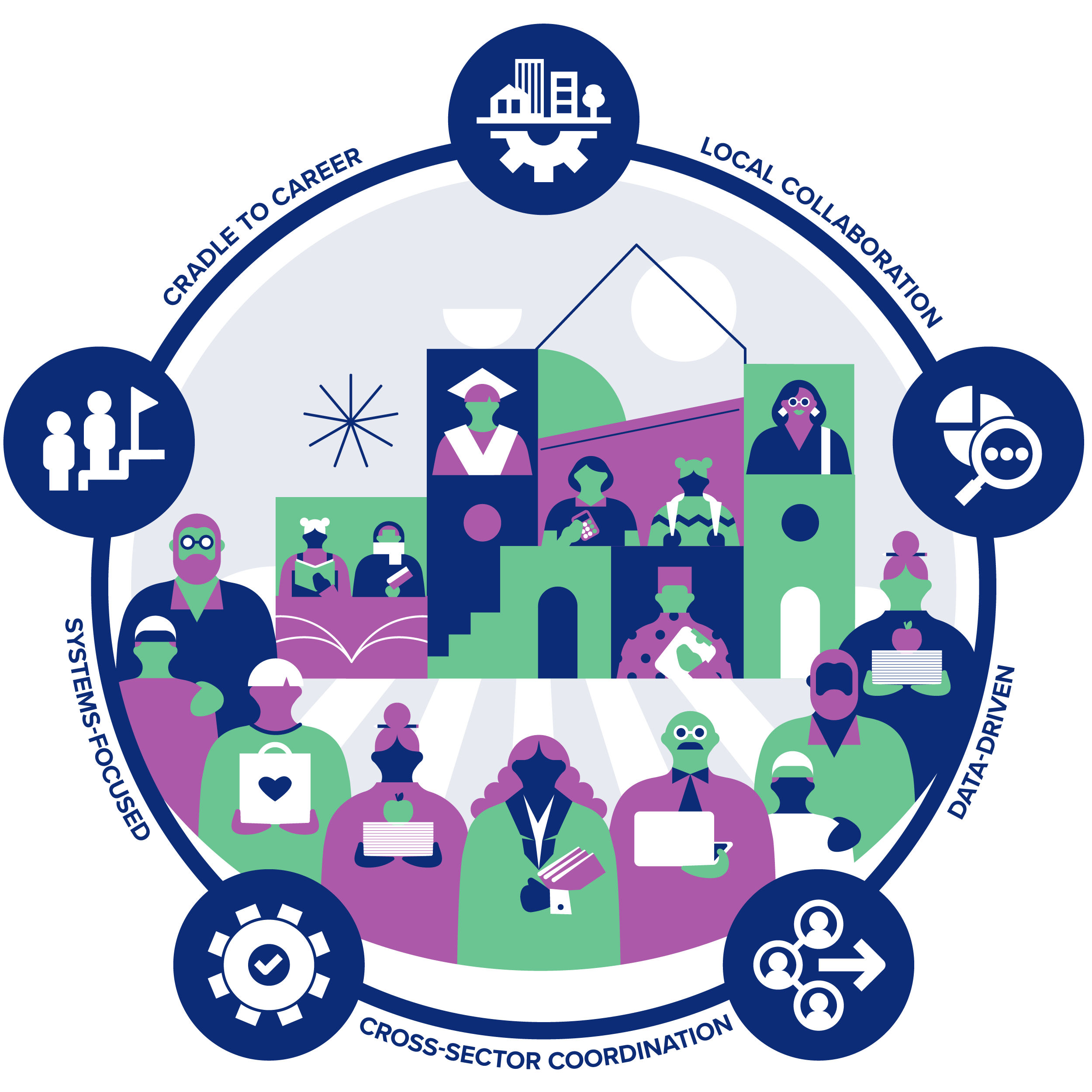
Place Based Partnerships (PBPs) are collaborative networks of people and organizations in specific geographies who refuse to accept that a zip code pre-determines a family’s economic mobility.
Rather than focusing on single issues in isolation, PBPs work across sectors to drive change — because health, education, workforce and socio-economic outcomes are interconnected. With residents at their center and local leaders at their helm, PBPs create change you can measure, from cradle to career.
Effective Place Based Partnerships are driven by talent and use data and technology that drive breakthrough results, from a child’s first steps to a young adult’s first job.
5 Elements of PBPs
Place Based Partnerships all share the same five core elements to drive their results.
1. Cross-sector, long-term, resident-centered partnership in a defined geography
Clear geographic scope with documented accountability and partnership structures
Named and updated priorities
Defined and documented roles for both individual and collective action
2. Effective ongoing use of data
Agree on a core set of measurable outcomes
Report on progress toward timebound goals (overall and disaggregated)
Use data as a flashlight, not a hammer, to continuously improve programs and policies
3. Trusted coordinating entity (a backbone or community quarterback organization)
Expert coordination among partners at the regional and/or neighborhood levels
Endorsed and respected by community leaders and resident
Adequate capacity to deliver
4. Improve or change systems and programs to maximize impact
Invest new and existing public and private dollars to sustain and scale what works
Identify root causes with residents and other experts, and change systems accordingly
5. Quality services and supports along the entire cradle-to-career continuum
Use tools to understand what children and families need and how those needs are (or are not) being met
Ensure seamless handoffs to high quality services and supports over the long-term
Outcomes of cradle-to-career PBPs
We know Place Based Partnerships are working when there are shifts in outcomes along the cradle-to-career continuum that create a path to economic mobility.
Kindergarten Readiness
Children who come to kindergarten ready to learn are more likely to be good readers in third grade.
Early Grade Reading
Reading well in third grade is an important predictor of success in school.
Middle School Math
Students that do well in Algebra are more likely to succeed in college.
High School Graduation
High school graduation is a prerequisite for attending college or earning a credential.
Postsecondary Enrollment
Postsecondary Completion
Postsecondary enrollment and completion leads to better employment prospects and more earning power.
Employment
Outcomes of cradle-to-career PBPs
We know PBPs are working when there are shifts in outcomes along the cradle-to-career continuum that creates a path to economic mobility.
Kindergarten Readiness
Children who come to kindergarten ready to learn are more likely to be good readers in third grade.
Early Grade Reading
Reading well in third grade is an important predictor of success in school.
Middle School Math
Students that do well in Algebra are more likely to succeed in colleege.
High School Graduation
High school graduation is a prerequisite for attending college or earning a credential.
Postsecondary Enrollment
Postsecondary Completion
Postsecondary enrollment and completion leads to better employment prospects and more earning power.
Employment
Social Environment and Political Capital
Supportive and protective personal relationships and networks
Built Evironment
Access to reliable housing, amenities, and transportation
Public Systems and Infrastructure
Government infrastructure exists on all levels to address market failures and gaps towards economic mobility
*The Comprehensive Framework that this information derives from was developed by the Social Genome Project, a partnership between the Brookings Center on Children and Families, the Urban Institute, and Child Trends, and is supported by multiple studies.
Lorem ipsum dolor sit amet, consectetur adipiscing elit, sed do eiusmod tempor Incididunt ut labore et dolore magna. Lorem ipsum dolor sit amet, consectetur adipiscing elit, sed do eiusmod tempor Incididunt ut labore et dolore magna.
*The Comprehensive Framework that this information derives from was developed by the Social Genome Project, a partnership between the Brookings Center on Children and Families, the Urban Institute, and Child Trends, and is supported by multiple studies.
Outcomes of place-based partnerships
Kindergarten Readiness
Preschool Enrollment
Parental engagement/education levels
Access to quality programming
Early Grade Reading Proficiency
School Attendance
Behavioral incidents
Access to quality enrichment programs (ex. tutoring)
Sense of belonging
Middle Grade Math Proficiency
School attendance
Behavioral incidents
Access to quality enrichment prgrams (ex. tutoring)
Sense of belonging
High School Graduation Rates
School Attendance
Behavioral incidents
Access to quality enrichment programs (ex. tutoring)
Sense of belonging
Postsecondary enrollment
Access to financial aid
Access to advising
Postsec Credit completion in HS
Postsecondary completion
Credit accumulation
Access to culturally relevant support
Sustained financial aid supports
Employment/job placement rates
Living wage jobs
Access to mentorships/internships/apprenticeships
Place Based Partnerships drive measurable outcomes
Explore these additional EdRedesign resources and case studies that demonstrate the power of PBPs.
The EdRedesign Lab at Harvard Graduate School of Education provides catalytic support to the cradle-to-career place-based partnership field to drive systems-level change and open personalized pathways to opportunity so that all children, youth, and families can thrive. EdRedesign pairs two key strategies—cross-sector place-based partnerships and personalized, relationship-based supports—to drive transformational, systems-level change that serves the needs, talents, and aspirations of individual children and youth and their families. EdRedesign’s work focuses on talent development, actionable research, and movement building. Learn more at www.edredesign.org.


















 Every Child and Family is Known
 Poughkeepsie, NY Children's Cabinet
 Dayton, Ohio Hope Zone